







|
Mekong River
The Mekong is one of the
world’s major rivers. It is the 11th-longest river in the
world, and the 12th-largest by volume (discharging 475
km³/114 cu mi of water annually). Its estimated length is
4,880 km (3,032 mi), and it drains an area of 810,000 km²
(313,000 sq mi). From the Tibetan Plateau it runs through
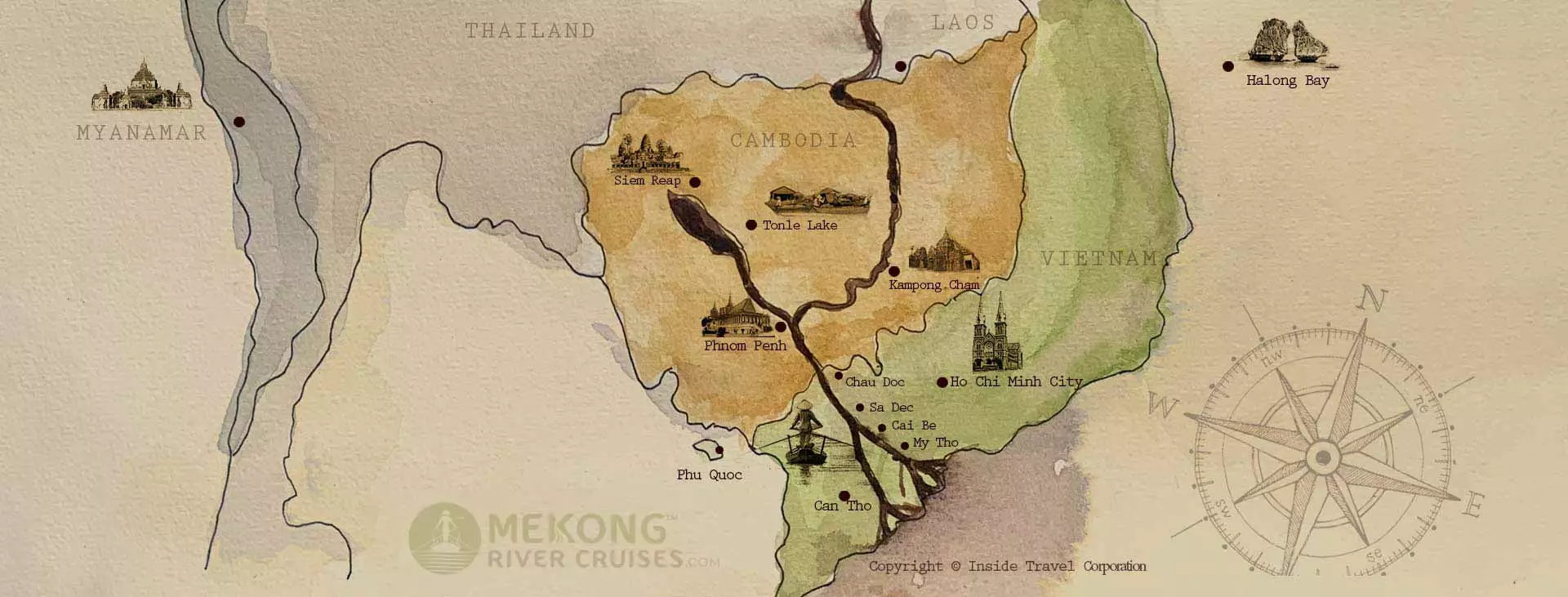
China's Yunnan province, Burma, Thailand, Laos, Cambodia
and Vietnam. All except China and Burma belong to the
Mekong River Commission. A south Asian regional
association, Mekong-Ganga Cooperation is named after this
river. The extreme seasonal variations in flow and the
presence of rapids and waterfalls have made navigation
extremely difficult.
The Mekong river basin is defined by the land area
surrounding all the streams and rivers that flow into
the Mekong river. This includes parts of China, Myanmar
and Viet Nam, nearly one third of Thailand and most of
Cambodia and Lao PDR. With a total land area of 795 000
square kilometers, the Mekong river basin is nearly the
size of France and Germany together. From its headwaters
thousands of meters high on the Tibetan Plateau, it
flows through six distinct geographical regions, each
with characteristic features of elevation, topography
and land cover. It would take 2 days of twenty-four hour
driving at 100 km per hour to drive the same distance as
the length of the Mekong river (4800 km).
The most abundant resources in the Mekong basin are
water and biodiversity. Only the Amazon River basin has
greater diversity of plant and animal life. So much
water flows into the mainstream Mekong from the
surrounding basin area that, on average, 15,000 cubic
meters of water passes by every second. In many parts of
the world, that's enough water to supply all the needs
of 100,000 people – the population of a large town – for
a whole day. This water nourishes large tracts of forest
and wetlands which produce building materials, medicines
and food, provides habitats for thousands of species of
plants and animals and supports an inland capture
fishery with an estimated commercial value of US$2
billion dollars per year. Known mineral resources
include tin, copper, iron ore, natural gas, potash, gem
stones and gold.
|